Florida removes several of the variables that make offsites hard. With over 125 public-use airports and 21 commercial-service airports statewide, getting leadership teams in from multiple cities is genuinely manageable. The Gulf Coast and South Florida waterfront settings do more than look good — the APA links nature exposure to improved attention, lower stress, and stronger working memory, which makes coastal environments a functional choice, not just an aesthetic one. Add year-round accessibility and the range of settings from private Gulf estates to Fort Lauderdale canal homes, and Florida covers more planning scenarios than most destinations.
This guide walks through goals, budgeting, Florida destination selection, a phased checklist, agenda design, and post-retreat follow-through.
Key Takeaways
- Define 2-3 specific outcomes before booking anything
- Lock the venue 10-12 weeks out; private coastal properties fill early
- Build a 60/40 agenda: structured sessions plus intentional downtime
- Collect dietary and logistics needs at the 6-8 week mark
- Reconfirm caterers, transport, and facilitators 72 hours before arrival
- Send a structured debrief summary within 48 hours of closing
Start with Strategy: Set Goals and Budget Before Anything Else
The most common executive retreat failure doesn't happen at the venue — it happens before any venue is chosen, when someone locks in a property before anyone has answered: what does success actually look like at the end of this?
Without a clear answer, venue choice becomes a preference exercise, the agenda fills up with presentations, and attendees leave feeling like they attended a meeting in a nicer location.
Define Outcomes First
Aim for 2-3 specific, nameable outcomes before planning begins. Not "team alignment" — that's a category, not a result. More like:
- A decision made on a specific strategic priority
- A restructured go-forward plan with named owners
- A trust-building milestone for a team that's been operating remotely
HBR's executive retreat guidance is direct on this: retreats should focus on high-level strategic issues and collective problem-solving, not routine tactical updates. SHRM identifies PowerPoint overuse and lack of audience involvement as the two most common reasons retreats underperform.
Run brief stakeholder conversations before planning starts — short 1:1 check-ins or a pre-retreat survey. This surfaces what people actually need, increases buy-in, and cuts the last-minute friction that comes when attendees feel the agenda was built without them.
Build a Realistic Budget
GBTA/CWT projected the average daily cost per attendee for meetings and events at $162 in 2024 and approximately $169 in 2025 — treat this as a directional corporate meetings benchmark, not a Florida private-property rate. Executive retreats with high-end accommodation and facilitation run considerably higher.
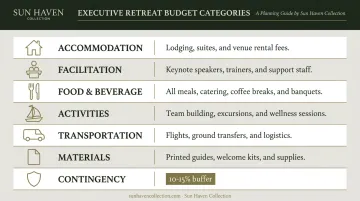
Main cost categories to plan for:
| Category | Notes |
|---|---|
| Accommodation | Largest variable — private estates vs. hotel blocks |
| Facilitation | External facilitator or executive coach if applicable |
| Food & beverage | Catering, private chef, group dinners |
| Activities | Charters, experiences, team programming |
| Transportation | Group transfers, airport pickups |
| Materials | Pre-reads, printed frameworks, tech |
| Contingency | 10-15% buffer for every budget |
Budget approval moves faster when the investment is tied to outcomes. A one-page summary that connects cost to a specific stalled decision, a leadership alignment gap, or a team dynamic issue will get sign-off faster than a line-item spreadsheet with no narrative. Build the story before you build the spreadsheet.
Choosing the Right Florida Location and Venue
The setting shapes what kind of conversation is possible. A hotel conference room signals business as usual. A private coastal home signals something different — and that shift in environment directly affects the quality of thinking that follows.
For executive retreats, three things matter most: privacy, space to move between sessions, and an environment that creates psychological distance from the day-to-day. Florida's Gulf Coast and South Florida waterfront both deliver this, but in different ways.
Florida's Top Retreat Regions for Executive Groups
Emerald Coast (Santa Rosa Beach, Panama City Beach)
South Walton stretches across 26 miles of Gulf Coast beaches with 16 distinct beach neighborhoods, sitting about 35 miles from both Northwest Florida Beaches International Airport (ECP) and Destin-Fort Walton Beach Airport (VPS). The pace here is slower — a deliberate contrast to the workweek that groups often need.
Sun Haven Collection properties in this corridor include Sea Breeze Sanctuary in Santa Rosa Beach (10 bedrooms, 30 guests), Albatross Retreat at Bid-A-Wee in Panama City Beach (8 bedrooms, 30 guests), and Surf House in Panama City Beach (7 bedrooms, 18 guests) — a strong fit for leadership teams of 12-16 who want space without renting rooms they won't use.
Fort Lauderdale
For groups traveling from multiple cities, Fort Lauderdale is the more practical hub. FLL served 32.2 million passengers in 2025, making it one of the most accessible airports on the East Coast. The city's 300 miles of navigable inland waterways and 24 miles of beaches give it a waterfront character that feels genuinely different from a standard business trip.
Sun Haven's four Fort Lauderdale properties — Sublime on Sixth, 15th Avenue Retreat, Second Street Sol, and Tide and Twenty-Six — each accommodate 10 guests across 5 bedrooms. All four offer canal views, walkable access to Las Olas Boulevard, and layouts built for open gathering rather than corridor living.
Private Home vs. Hotel: Which Works Better?
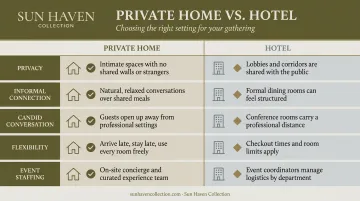
For executive groups of 8-20, private homes consistently outperform hotels on the dimensions that matter most for retreats.
| Factor | Private Home | Hotel |
|---|---|---|
| Privacy | High — closed environment | Low — shared lobbies and hallways |
| Informal connection | Continuous — shared common spaces | Fragmented — executives disperse to rooms |
| Candid conversation | More likely in home-style settings | Harder in formal meeting rooms |
| Flexibility | Meals, spaces, schedule are yours | Bound by hotel catering and room policy |
| Event staffing | Concierge support (via Sun Haven) | On-site event staff |
The practical checklist for private venue verification:
- Confirmed Wi-Fi speed and reliability (Sun Haven properties include high-speed WiFi standard; confirm details with concierge for bandwidth-heavy needs)
- Sleeping capacity vs. common space — can 15 people comfortably gather without crowding?
- Outdoor space for breakout conversations and post-session decompression
- Parking or group transfer logistics
- Proximity to catering providers or local dining
- Contract terms including cancellation and modification clauses
The Executive Retreat Planning Checklist
10-12 Weeks Out
- Finalize retreat purpose and define 2-3 specific outcomes
- Identify all attendees and confirm participation (check against quarterly closes, board meetings, major travel)
- Set total budget and get approval
- Begin venue search — shortlist private properties and contact directly
- Assign a planning lead who will not serve as the lead facilitator during the retreat
6-8 Weeks Out
- Book venue and confirm contract terms — this is the decision that locks everything else downstream
- Arrange group travel and airport transfers
- Confirm external facilitator or speaker if needed
- Draft agenda framework tied to stated outcomes
- Send save-the-date with purpose statement, location, and attire guidance
- Begin collecting dietary restrictions and accommodation preferences
- Inquire about Sun Haven's Executive & Group Offsites package if using a private estate — meeting setup (AV, seating), catering, and team-building coordination are available through their concierge
2-4 Weeks Out
- Send full agenda with session expectations and any pre-read materials
- Confirm all vendors — catering, activities, transportation
- Share arrival logistics and self check-in details (Sun Haven properties use keypad entry, so staggered arrivals don't require staff on-site)
- Confirm technology needs: AV, presentation software, video conferencing for hybrid participants
- Verify any curated experience packages have been booked (private dining, outdoor experiences)
72 Hours Before and Day-Of
The 72-hour rule: call or message every vendor to confirm numbers, times, and access. Vendor staffing shifts, headcounts update, and access details get revised — a confirmation email reflects the moment you booked, not the day you arrive.
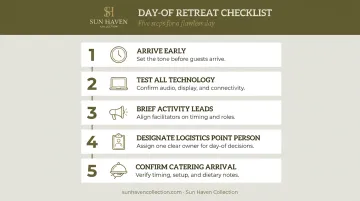
Day-of checklist:
- Arrive early — walk every room, test the AV, and reset anything that's off before the first attendee walks in
- Test all technology — run a full screen share and place a test video call with any remote participants
- Brief all activity leads — confirm exact timing, handoff cues, and what they do if a session runs long
- Designate a logistics point person who handles problems so the facilitator can stay present
- Confirm catering arrival windows and property access for vendors
Sun Haven's concierge team is available 24/7 during stays and in the pre-arrival window, which gives retreat planners a reliable point of contact for same-day logistics questions.
A Note on Team Roles
The retreat planner and the retreat facilitator should never be the same person during the event. When the senior leader is managing where the lunch order is, they're not reading the room. For private home retreats, the property's concierge support becomes the logistics anchor — assign that relationship early, and be specific: share your vendor list, arrival windows, and any setup requirements before you land.
Designing an Agenda That Balances Work and Recovery
The most expensive agenda mistake: packing every hour. Executives need unstructured time not because they deserve a break, but because decisions made under cognitive load tend to be worse. The informal conversation after dinner often surfaces the honest obstacle that three hours of structured discussion didn't reach.
A Practical Daily Framework
Morning: Strategic or decision-heavy sessions while energy is fresh. This is the time for the topics that actually need to move.
Mid-day: Informal lunch — no presentations. This transition is part of the agenda, not a gap in it.
Afternoon: Collaborative or creative work. Processing what came up in the morning, working through implications together.
Early evening: An activity or walk before dinner. Movement helps integrate the day's thinking.
Dinner: Unstructured, connection-focused. Some of the best retreat outcomes come from conversations that happen here.
A two-day retreat built on this rhythm tends to outperform a single-day marathon. The overnight creates separation — people sleep on the morning's conversations and return with clearer perspectives.
Setting Measurable Checkpoints
Before the retreat starts, agree on what needs to be captured by the end of day one versus the end of the retreat. Assign one person the named responsibility of documenting decisions and commitments in real time — not as an afterthought, but as a defined role. Without that, key outcomes fade before anyone acts on them.
Before closing each day, confirm:
- Which decisions were made and who owns them
- What still needs resolution before the retreat ends
- Any commitments that require follow-up after the group returns
Activities Worth Building Into a Florida Executive Retreat
The right activity for an executive group does one specific thing: it lowers guard without feeling like another agenda item.
Florida's coastal settings give planners good options that are naturally low-pressure and conversation-friendly:
- Sunrise paddleboard sessions — morning timing avoids Gulf Coast afternoon weather, and the novelty is enough to get people talking
- Fishing charters — unstructured time on water, no presentations possible
- Private boat rentals (Fort Lauderdale's waterways are genuinely excellent for this)
- Guided kayak excursions near the Emerald Coast
- Private beach bonfires — evening, low-key, creates natural conversation clusters
- Gulf Coast golf — familiar enough to feel comfortable, social enough to be useful

The Gulf Coast rainy season runs from mid-May through mid-October, with afternoon and evening storms most frequent from July through early September. Plan outdoor activities in the morning window during summer months. Summer is still a viable retreat season — it just means building the schedule around the weather, not fighting it.
Sun Haven's concierge team can connect groups with local experience providers near both the Emerald Coast and Fort Lauderdale properties. The Pool & Outdoor Takeover and Private Dining & Culinary packages work well for on-property evening programming — both are designed for groups and can be coordinated through the concierge without retreat planners juggling separate vendors.
The goal is one signature activity the group references afterward — not a packed schedule that blurs together by the flight home.
Post-Retreat: Converting Momentum into Action
Within 48 hours of closing, send a structured debrief summary. This document should include:
- Key decisions made, with the rationale noted
- Commitments recorded with named owners and specific deadlines
- A brief summary of what the retreat was designed to accomplish and how it landed
This step separates retreats that generate lasting change from those that feel meaningful in the room and dissolve within a week.
One week out, collect structured feedback from attendees. Ask specifically:
- What worked well
- What felt rushed or underprepared
- What they want more of next time
Share responses with the planning team and update the checklist before the detail fades. Run this loop consistently and the retreat becomes an improving annual practice — not a planning project that starts from scratch each time.
Frequently Asked Questions
How much does an executive retreat cost?
GBTA/CWT benchmarks broad corporate meetings at approximately $162–$169 per attendee per day, but executive retreats with private-home accommodation and facilitation run 2–3× higher. The biggest cost drivers are accommodation type (private estate vs. hotel), external facilitation, and F&B for a captive group. Frame it against the strategic value of decisions accelerated or alignment achieved.
How do you plan an executive retreat?
Start by defining 2-3 specific outcomes before booking anything. Select your venue 10-12 weeks out, build an agenda that balances structured sessions with intentional downtime, assign a dedicated logistics lead who isn't the facilitator, and close with a structured follow-up process within 48 hours of the retreat ending.
What are common activities at an executive retreat?
Strategic workshops, facilitated discussions, outdoor physical activities, and shared meals are the standard mix. For executive groups, the best activities lower the guard — fishing charters, private boat experiences, morning paddleboard sessions, or beach bonfires — and create shared experiences that carry through the rest of the retreat.
How far in advance should you book an executive retreat in Florida?
Book at 10-12 weeks minimum. Private estate properties in Florida, particularly along the Emerald Coast and in Fort Lauderdale, fill quickly — especially during the October through April high season. Earlier booking also gives you more runway for agenda development, vendor coordination, and travel logistics.
What is the best time of year for an executive retreat in Florida?
October through April offers the most consistent outdoor conditions across most Florida regions. Gulf Coast properties are accessible year-round — summer works well if outdoor activities are scheduled in the morning to avoid the May-October rainy season's afternoon storms, which peak from July through early September.
Should executives stay at a private home or hotel for a retreat?
Private homes tend to work better for groups of 8-20 because they keep the team together in a shared environment, enable candid conversation in informal spaces, and create a closed-door atmosphere that executives consistently describe as more productive. Hotels are better suited to larger conferences where breakout space and dedicated event staffing are the primary priorities.